
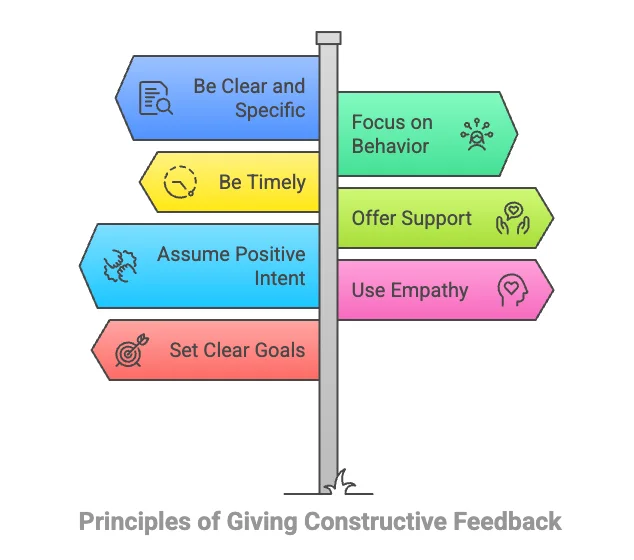
Most managers know feedback matters, but many quietly avoid it — worried about hurting feelings, causing conflict, or simply not knowing how to phrase it well. The result is often either silence (until a real problem forces a difficult conversation) or feedback delivered so bluntly it damages motivation rather than improving performance. Constructive feedback, done right, avoids both extremes.
What Makes Feedback Genuinely “Constructive”
Constructive feedback focuses specifically on behaviour and outcomes, not personal character, and pairs honest observation with a clear, actionable path forward — leaving the employee with something concrete to actually improve, rather than just a feeling of criticism.
Step 1: Time It Close to the Actual Event
Feedback given weeks after an incident loses impact and specificity. Address issues (and wins) as close to the moment as reasonably possible, while details are still fresh for both parties.
Step 2: Use the Situation-Behaviour-Impact Framework
- Situation: Describe the specific context, not a vague generalisation
- Behaviour: State exactly what was said or done, factually
- Impact: Explain the actual effect it had on the team, client, or outcome
This structure keeps constructive feedback factual and specific rather than accusatory.
Step 3: Balance Genuine Strengths With Areas to Improve
Avoid the common mistake of forced “feedback sandwiches” that feel formulaic — instead, acknowledge specific genuine strengths naturally within the conversation, then address the growth area clearly and directly.
Step 4: Make It a Conversation, Not a Monologue
Ask the employee for their perspective before jumping to conclusions — sometimes there’s context you’re missing, and even when there isn’t, involving them in identifying solutions increases buy-in significantly compared to being simply told what to fix.
Step 5: Focus on One or Two Key Points, Not Everything at Once
Overloading an employee with five different issues in one conversation is overwhelming and demotivating. Prioritise the one or two changes that would have the biggest actual impact, and save smaller points for future conversations.
Step 6: Follow Up and Recognise Improvement
Constructive feedback loses its power if it’s a one-time event with no follow-up. Checking in later and specifically acknowledging improvement reinforces the behaviour change far more effectively than the initial feedback conversation alone.
Step 7: Choose Private Settings for Individual Feedback
Public criticism, even when well-intentioned, damages trust and can cause defensive reactions that block the message from actually landing. Reserve group settings for positive recognition, and keep improvement-focused conversations private.
FAQ
How often should managers give constructive feedback? Regular, ongoing feedback — ideally in frequent one-on-ones rather than only during formal annual reviews — helps employees adjust course continuously rather than facing a pile-up of issues once a year.
What’s the difference between constructive feedback and criticism? Constructive feedback focuses on specific behaviour with a clear path to improvement, while criticism often feels more general, personal, and lacks actionable direction.
How do I give feedback to a defensive employee? Starting with genuine curiosity — asking about their perspective before stating your observation — often reduces defensiveness compared to leading immediately with the critical point.
Should feedback always be given in person? Where possible, yes, especially for sensitive topics — tone and nuance are harder to convey accurately over email or chat, increasing the risk of misinterpretation.
How do I handle giving feedback to someone more senior or experienced than me? Framing feedback around specific outcomes and asking questions rather than issuing directives often works better when giving feedback upward, respecting their experience while still addressing the issue.
What should I do if an employee doesn’t respond well to feedback? Give them space to process, follow up individually afterward, and focus on keeping the door open for further conversation rather than escalating in the moment.
Conclusion
Constructive feedback is one of the highest-leverage leadership skills precisely because it directly shapes both performance and how motivated people feel coming to work each day. By focusing on specific behaviour, keeping conversations balanced and timely, and following up on progress, managers can address real issues without the demotivation that often comes from feedback delivered carelessly. The goal isn’t to avoid difficult conversations — it’s to have them in a way that actually helps people grow.
[link to related guide about servant leadership and retention here] [link to related guide about managing remote teams across time zones here]
Suggested image alt text:
- “manager giving one-on-one feedback to employee in office”
- “team lead having private feedback conversation with staff member”
- “employee receiving constructive feedback notes during review”